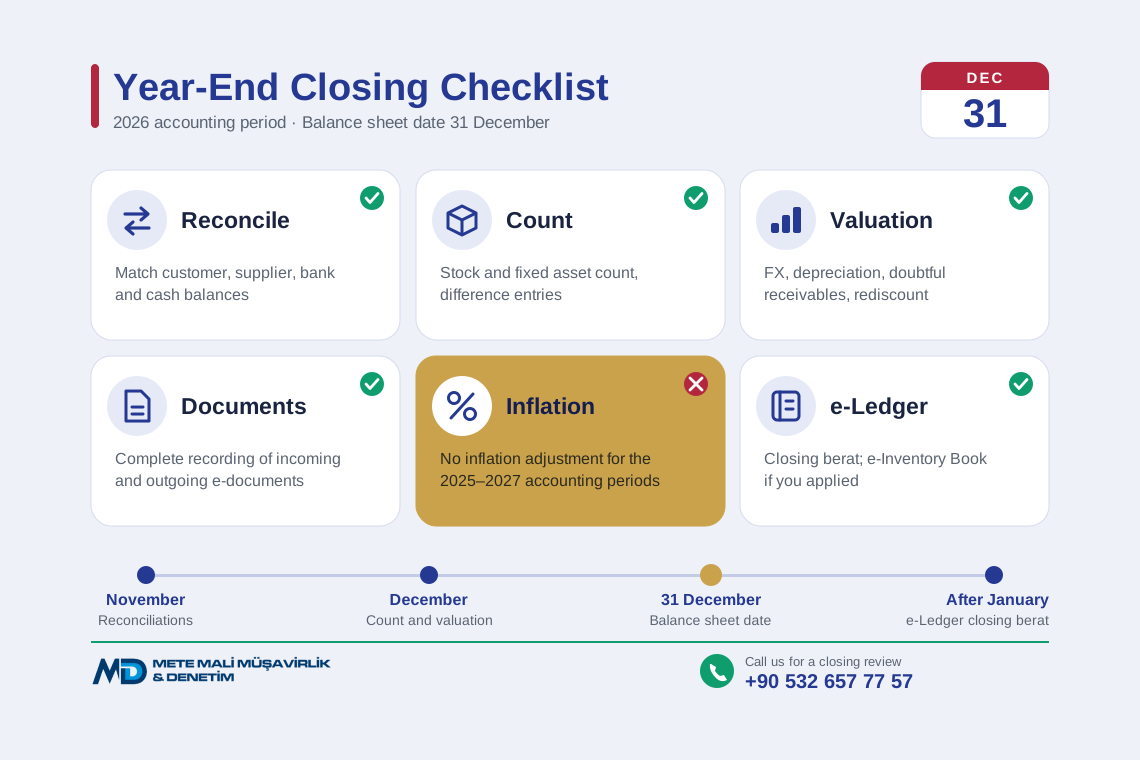
Year-end is when legal obligations, profit and the tax base all become final for companies that keep books on a balance sheet basis. Counts, reconciliations and valuation entries made in an orderly way starting in November, rather than in a rush in December, reduce errors and rework. In this article we have put together the 2026 year-end steps for inventory, reconciliation, valuation and closing the books as a checklist.
İçindekiler
Why Does the Year-End Close Matter?
Under Article 186 of the Tax Procedure Law (VUK), taking inventory means determining exactly and in detail the assets, receivables and payables on the balance sheet date by counting, measuring, weighing and valuing them. Businesses that keep books on a balance sheet basis must do this at the end of every accounting period.
- Stock, receivables, payables and fixed asset amounts enter the balance sheet according to the results of these procedures, so they directly affect the period’s profit and the tax base.
- Missing or wrong entries create correction costs and tax audit risk in later periods.
- The reliability of financial statements prepared for bank loans, investments and shareholders also depends on the quality of the close.
Preparations for November and December
- Account reconciliations: Compare balances with key customers and suppliers and investigate differences before the year ends. Keep the reconciliation letters on file.
- Bank and cash check: Match bank statements with book balances. Physically count the cash on hand against the recorded amount; the cash account should never have a credit balance.
- Document recording check: Confirm that all incoming and outgoing documents in your e-invoice, e-archive and e-waybill boxes have been recorded.
- VAT and withholding consistency: Make sure the returns filed during the year are consistent with the accounting records.
- Shareholder, employee and advance accounts: Review the justification and documents behind balances with shareholders and employees.
- Cheque and note portfolio: Check maturities of cheques and notes in the portfolio, separately for those in collection and those that bounced.
Inventory and Stock Count
The stock count is carried out as of the end of the accounting period, and the stock value found is shown on the balance sheet. The count covers merchandise, raw materials, semi-finished goods and finished goods.
- Decide the counting team and date in advance; stop movements during the count or record them separately.
- Keep signed and dated count sheets and compare them with book records (recorded stock).
- Investigate the cause of differences: an opening balance error, wrong document, waste, loss or an unrecorded outflow may be the reason. Different causes lead to different entries and tax consequences.
- Determine the cost of goods sold after the count and record it.
- Physically check lists of fixed assets (furniture, machinery, vehicles) too, and remove unused or sold assets from the records.
Valuation Procedures
- Foreign currency items: Foreign currency cash, bank balances, receivables and payables are valued at the year-end rate under Article 280 of the VUK; exchange differences are reflected in the period’s results.
- Depreciation: Reconcile your depreciation schedule with the trial balance; check rates, dates of capitalization and assets bought or sold during the year.
- Doubtful receivables: Assess whether legal follow-up and the conditions for a provision are met for receivables that cannot be collected. To book a provision, the receivable must be commercial in nature, recorded in the books and have become doubtful.
- Rediscounting: If rediscounting is applied to receivables and payables backed by notes, it must be applied to all notes in the same way; applying it to some notes and not others is not possible.
- Accruals: Identify expenses that belong to the period but have not yet been invoiced, and prepayments that belong to future periods.
Each item has different tax rules. Especially for items such as doubtful receivables and exchange differences, an incorrect entry can directly affect the tax base.
No Inflation Adjustment in 2026, but Revaluation Is an Option
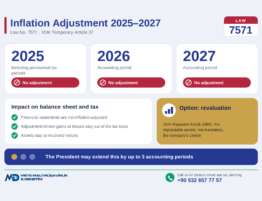
- Because of Law No. 7571, no adjustment under VUK Repeated Article 298/A will be made in the 2025, 2026 and 2027 accounting periods even if the conditions are met.
- Since these periods are treated as periods in which the inflation adjustment conditions are not met, the revaluation option for depreciable economic assets under VUK Repeated Article 298/Ç remains available. Revaluation is not mandatory; it is the business’s choice.
- The use of the revaluation fund and the consequences of later selling the asset are governed by separate rules. We recommend having your CPA calculate the applicable rate and its effect before year-end.
Not making an inflation adjustment also has other consequences for the balance sheet and taxes; we will cover this in a separate article.
Books and e-Ledger Closing
- If you use the e-Ledger (e-Defter): A separate physical closing certification is not required. The close is completed by uploading the ledgers and approval files (berat) for the last month of the accounting period to the Revenue Administration (GİB) system and obtaining the approved berat. The upload deadline for December is set by GİB announcements; plan a calendar with your CPA so you do not miss it.
- e-Inventory Book (e-Envanter Defteri): E-Ledger users can keep it on an optional basis from 1 January 2026. If you have applied, you also need to create the closing inventory book and its berat as of the end of the accounting period.
- If you use paper books: The closing certification of the 2026 journal book must be completed by 30 June 2027 at the latest.
- New year preparation: Check the 2027 book opening, your e-Ledger upload preference and software settings before January.
Year-End Checklist
- Complete account reconciliations with key customers and suppliers.
- Verify bank and cash balances as of 31 December.
- Count stock and fixed assets, and document differences.
- Value foreign currency items at the year-end rate.
- Review depreciation, doubtful receivable and rediscount entries.
- Decide whether to apply revaluation.
- Check that all incoming and outgoing e-documents are recorded.
- Set the closing calendar for the e-Ledger and, if you applied, the e-Inventory Book.
- Document the justification for shareholder and employee accounts.
- Review the financial statements after the close and present them to management.
At Mete CPA & Auditing, we support you from year-end reconciliations to inventory and valuation entries, e-Ledger closing and the preparation of financial statements. Contact us to plan your company’s closing process together.