In high-inflation years, adjusting balance sheets for inflation directly affected companies’ profit, tax and equity figures. The new rule suspends this practice for 2025, 2026 and 2027. This article summarizes what the rule says, what it means for the balance sheet and tax, and which options remain.
İçindekiler
What Does the Rule Say?
- Scope: In the 2025 accounting period (including provisional tax periods) and in the 2026 and 2027 accounting periods, financial statements are not subject to inflation adjustment, regardless of whether the conditions under VUK Repeated Article 298 are met.
- Special accounting periods: For taxpayers assigned a special accounting period, the periods ending in 2026, 2027 and 2028 are taken as the basis.
- Power to extend: The President may extend these periods by up to three accounting periods, including provisional tax periods. In other words, the timeframe may change in the future.
- Entry into force and implementation: The provision entered into force on its publication date, 25 December 2025. The Ministry of Treasury and Finance determines the procedures and principles of implementation.
What Happens to the Balance Sheet?
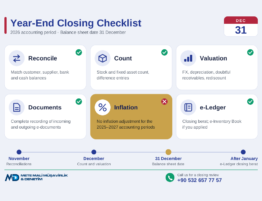
- No inflation adjustment entries are made in the balance sheet and income statement; non-monetary items (inventory, property, plant and equipment, equity) are not adjusted.
- Assets continue to be carried at their recorded values under the VUK valuation rules. Classic year-end procedures such as inventory, foreign currency valuation and depreciation continue as usual.
- Because no adjustment is made, no difference arises in the inflation adjustment account.
- No adjustment is made in provisional tax periods either; provisional tax returns are prepared on unadjusted financial statements.
What Happens to Tax?
- The corporate and income tax base is not affected by profit or loss items arising from inflation adjustment; the base is calculated on conventional VUK records.
- Unless revaluation is carried out, depreciation is charged on recorded values rather than adjusted values.
- In a high-inflation environment, the gap between recorded values and actual values may widen. This is a point to consider separately in tax planning.
The Revaluation Option (Article 298/Ç) Continues
- Periods in which no inflation adjustment is made (including extended periods) are treated as “periods in which the conditions for inflation adjustment were not met” for the purposes of paragraph (Ç) of VUK Repeated Article 298.
- As a result, revaluation of depreciable fixed assets remains available. Revaluation is not mandatory; it is the company’s choice.
- The use of the resulting revaluation fund and the consequences of selling the asset later are subject to separate rules. We recommend having your accountant calculate the applicable rate and its effect before year-end.
Financial Reporting and Audit
This rule concerns financial statements kept under the tax legislation (VUK). Financial statements prepared under Turkish Financial Reporting Standards, or reporting within an independent audit, may need a separate assessment. We recommend working on this together with your auditor and accountant.
Checklist for Companies
- Confirm that your returns, including 2025 provisional tax periods, were prepared without inflation adjustment.
- Base your 2026 year-end planning on an unadjusted balance sheet.
- Have the cost and benefit of the revaluation option calculated for your depreciable assets.
- If you use a special accounting period, check which periods are covered.
- Monitor whether the period is extended by Presidential decision.
At Mete CPA & Auditing, we review your balance sheet and tax planning, your revaluation decision and your year-end closing together during this period in which inflation adjustment is suspended. Contact us to review your company’s situation.