The Central Bank of the Republic of Turkey (CBRT) has renewed its program supporting exporting companies in converting their foreign-currency export proceeds into Turkish Lira. The new “Implementation Instruction Related to the Communiqué on Supporting the Conversion of Companies’ Foreign-Source Foreign Currency into Turkish Lira,” published on September 26, 2026 and effective as of October 1, 2026, repeals the previous instruction dated January 26, 2023, and updates the entire process. In this article, we summarize the scope of the support, the application conditions, how company sales limits are determined, and the key points exporters need to watch.
İçindekiler
Currencies Covered by the Support
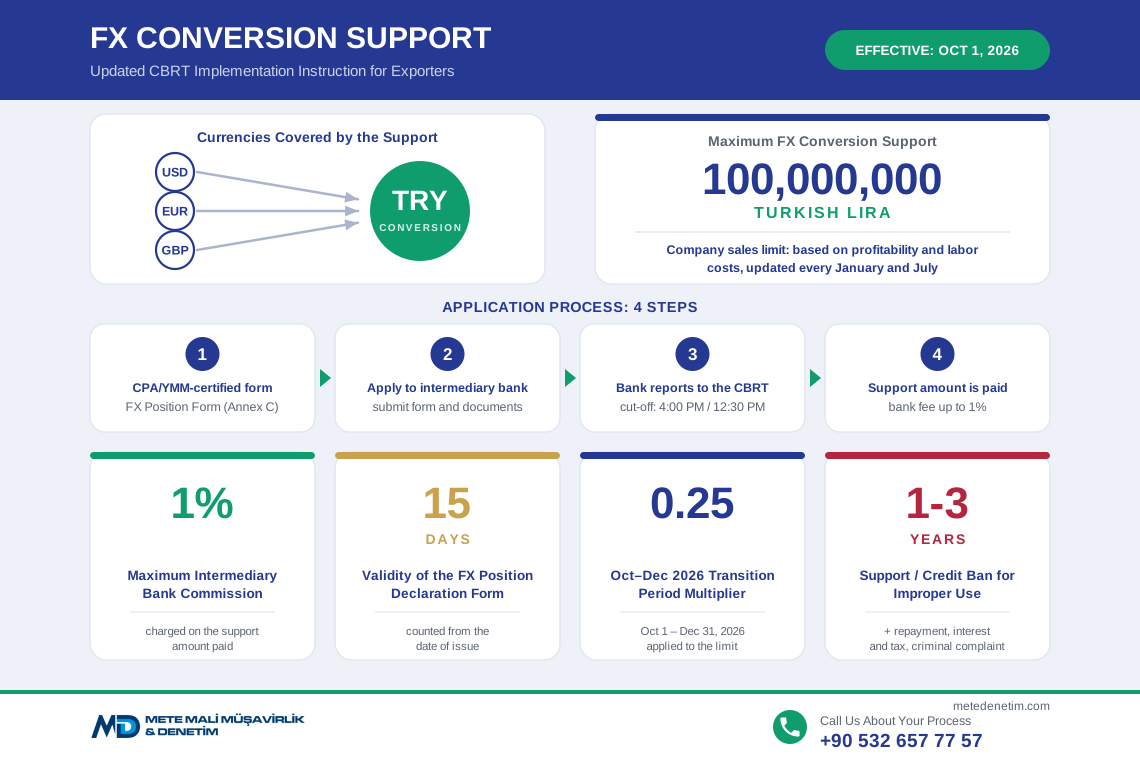
Under the Implementation Instruction, the currencies eligible for the foreign-exchange conversion support are limited to the US Dollar, Euro, and British Pound. Companies can benefit from the support by selling these currencies — when in the nature of export proceeds or advance export proceeds — to the Central Bank through intermediary banks. For a complete export file closure, also see our guide to closing an export customs declaration (GÇB).
Conditions for Benefiting from the Support
The main conditions for benefiting from the foreign-exchange conversion support are as follows:
- The foreign currency being sold must be in the nature of export proceeds or advance export proceeds.
- The maximum foreign-exchange conversion support a company can receive under this scope is capped at TRY 100,000,000 (one hundred million).
- The company’s foreign-exchange position ratio (the ratio of foreign-currency assets to net sales revenue) must not exceed the ceiling set by the Central Bank.
- The Foreign Exchange Position Declaration Form is valid for 15 days from its date of issue.
- For companies operating under an intermediary export contract, a mechanism is also provided allowing the support payment to be made directly to the supplier/manufacturer company.
How Are Company Sales Limits Determined?
The maximum amount of foreign currency each company can sell to the Central Bank (the company sales limit) is calculated based on criteria such as the company’s profitability and labor costs, and is updated twice a year, in January and July. There is also a transitional provision specific to the October 1 – December 31, 2026 period, during which the company sales limit and the maximum foreign-exchange conversion support amount are applied multiplied by a factor of 0.25; amounts sold or benefited from by companies prior to this date are not taken into account in this calculation.
CPA-Certified Foreign Exchange Position Declaration Form
Companies applying for the support must complete the Foreign Exchange Position Declaration Form (Annex: C), which shows their active and passive foreign-currency/gold assets and liabilities, and have it certified by an independent accountant/financial advisor (SMMM) or a certified public accountant (YMM). The form requires an accurate calculation of ready foreign-currency assets, net sales revenue, and the foreign-exchange position ratio, after which it must be signed by company officials and submitted to the intermediary bank. Inaccurate or incomplete information on the form can result in serious sanctions.
The Role of Intermediary Banks and the Process
Intermediary banks check companies’ certificates of activity, their CPA/YMM-certified declaration forms, and other required documents, report the transactions to the Central Bank electronically, and carry out the controls required under anti-money-laundering and counter-terrorist-financing legislation. Notifications are transmitted to the Central Bank by 4:00 PM on full business days and by 12:30 PM on half business days. Intermediary banks may charge a commission of up to 1% of the foreign-exchange conversion support amount paid to companies.
Consequences of False Declarations and Improper Use
If it is determined that a company has benefited from the foreign-exchange conversion support improperly, for a purpose other than intended, or by submitting false information or documents, the support amount paid is clawed back together with interest — calculated at the highest overnight lending rate in effect on the date of detection — plus the Banking and Insurance Transactions Tax. In addition, the company’s requests for the conversion support and for Central Bank-sourced credit are rejected for 1 year following the first detection and for 3 years following any subsequent detection, and a criminal complaint may be filed against the responsible parties.
Why It Matters
This regulation offers a significant financing and currency-risk-management tool, particularly for exporting companies with high foreign-currency revenue. However, the accurate preparation of the CPA/YMM-certified Foreign Exchange Position Declaration Form and the correct calculation of the company sales limit sit at the heart of the process; an error or incomplete declaration on the form can result in the support being clawed back and years of restrictions. Details such as the 0.25 multiplier applicable during the October–December 2026 transition period should also not be overlooked.
At Mete CPA & Auditing, we support you through every step of the foreign-exchange conversion support process — from having your Foreign Exchange Position Declaration Form certified by a CPA/YMM to accurately calculating your company sales limit. Contact us to evaluate your process for converting export revenue into Turkish Lira.