When a company holds cash in excess of its ordinary business needs, or lends money to its partners, one of the most common issues raised in tax audits is which interest rate should be used in the “adat” calculation — the notional interest calculation applied to such balances. Turkey’s Council of State (Danıştay) has established a clear line of precedent on this issue. In this article, we explain what the adat calculation is, which interest rate should be used according to the Council of State, and its tax consequences.
İçindekiler
What Is the Adat Calculation?
“Adat” refers to the notional interest calculation applied to cash held in a company’s till in excess of its ordinary operating needs, or to funds lent to partners without charge. The tax administration closely monitors such situations, treating them as carrying a risk of disguised profit distribution when company resources are made available to partners or related parties free of charge. To eliminate this risk, taxpayers are expected to calculate notional interest on the amounts involved at a market rate and record it as income.
Which Interest Rate Should Be Used?
The order of priority for determining the applicable interest rate in an adat calculation is as follows:
- If an internal comparable exists: the interest rate applied to the company’s own bank loans should be used.
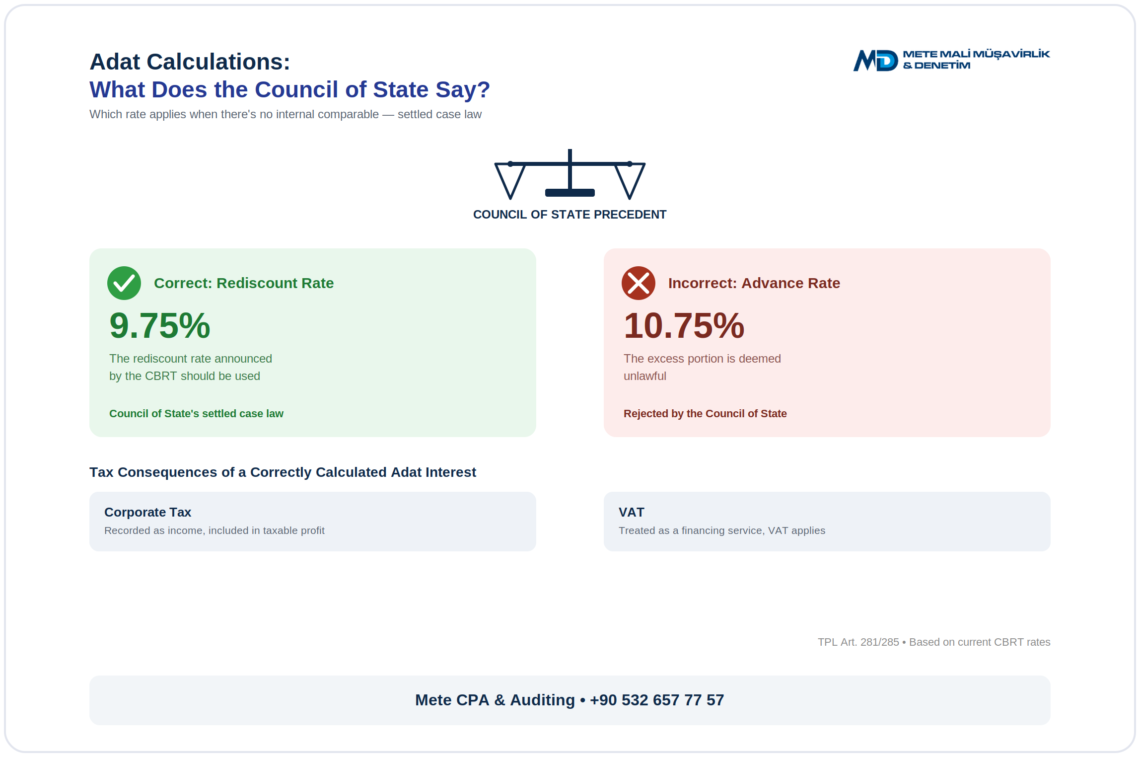
- If no internal comparable exists (external comparable): according to the Council of State’s well-established case law, the rediscount interest rate announced by the Central Bank of the Republic of Turkey (CBRT) should be used.
Why the Rediscount Rate, Not the Advance Rate?
In practice, the tax administration sometimes bases adat calculations during audits on the CBRT’s advance interest rate instead. However, the well-established approach adopted by the Council of State in numerous rulings finds this practice unlawful. According to the Council of State, the interest rate that should be applied in adat calculations relevant to determining the tax base is the rate applied to rediscount transactions; where a calculation is instead based on the advance interest rate, the portion exceeding the rediscount rate is considered unlawful. Since the rediscount and advance interest rates are set for different purposes, using one in place of the other is not accepted by the Council of State.
Current Rediscount and Advance Interest Rates
Rates set by the CBRT are updated periodically and take effect through communiqués published in the Official Gazette. As of the current period, the discount interest rate applied to rediscount transactions for bills with no more than 3 months remaining to maturity has been set at 9.75% annually, while the rate applied to advance transactions has been set at 10.75% annually. The gap between these two rates directly affects the direction and size of any tax base adjustment if the wrong rate is applied.
Tax Consequences of Adat Interest
Adat interest calculated at the correct rate gives rise to two separate tax obligations for the taxpayer:
- Corporate tax: the calculated adat interest is treated as income, included in the company’s taxable profit, and subject to corporate tax.
- VAT: since lending money to partners is treated as a financing service under the VAT Law, VAT must be calculated and declared on the adat interest amount.
Recommendations for Taxpayers
- Regularly monitor your till balance and amounts lent to partners; identify any excess over your ordinary cash needs.
- Check for an internal comparable first (your own bank loan interest rate, if any) when performing an adat calculation.
- If no internal comparable exists, base the calculation on the CBRT rediscount interest rate; avoid using the advance interest rate.
- If you face a tax assessment based on the advance interest rate during an audit, consider your right to object by citing the Council of State’s well-established case law.
- Review your adat interest calculations and related VAT/corporate tax filings together with your CPA.
At Mete CPA & Auditing, we support you throughout the entire process — from ensuring your adat calculations align with Council of State precedent, to preparing a solid defense in the event of a tax audit. Contact us to review your situation.