There’s a point business owners frequently confuse: the money that lands in the bank account is not the same as the business’s real profit. The VAT collected on a sale isn’t the business’s own earnings — it’s essentially being held in trust for the state. In this article, we walk through how a business’s real net profit is calculated, step by step, using an example.
İçindekiler
A Worked Example
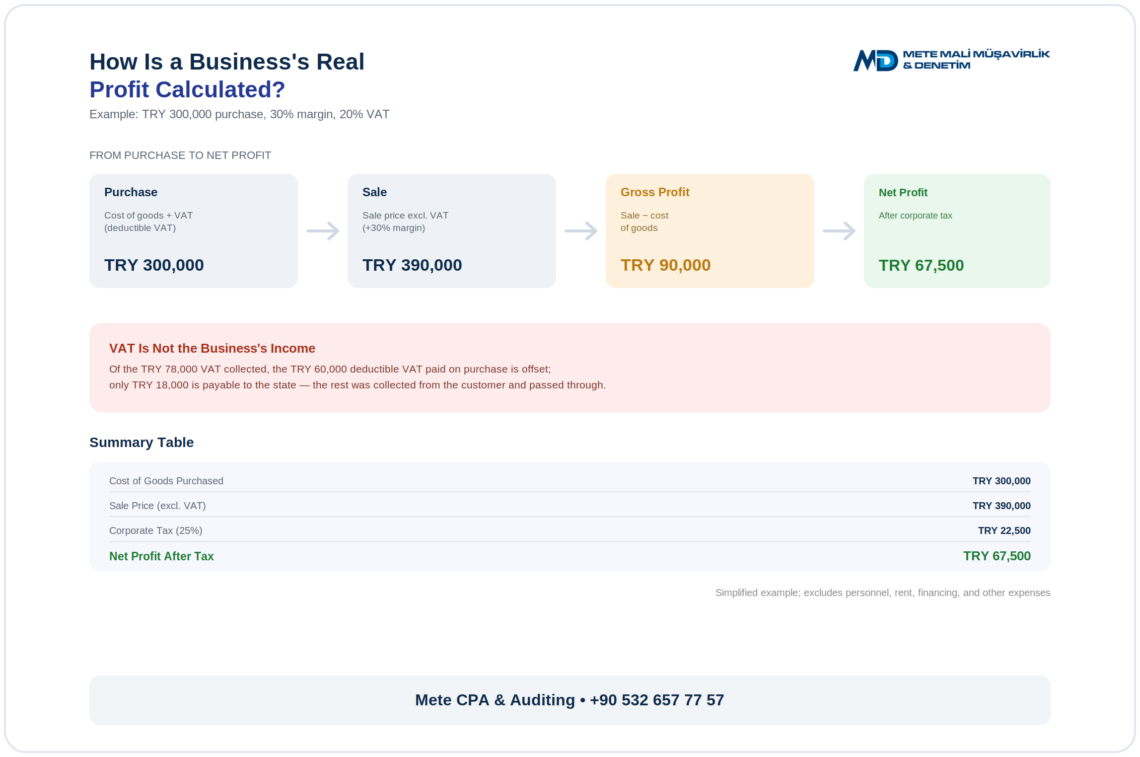
Let’s assume a business purchases goods for TRY 300,000 plus 20% VAT, and sells them with a 30% profit margin.
1. Purchase Stage
- Cost of Goods: TRY 300,000
- VAT (20%): TRY 60,000
- Total Payment: TRY 360,000
Important: This TRY 60,000 in VAT is not a cost to the business. It’s recorded as “deductible VAT” and later offset against the VAT collected on sales.
2. Sale Stage
- Sale Price (excl. VAT): TRY 390,000 (a 30% margin on TRY 300,000)
- VAT Calculated (20%): TRY 78,000
- Total Amount Collected: TRY 468,000
3. Trading Profit
Sale Price (excl. VAT) TRY 390,000 − Cost of Goods TRY 300,000 = Gross Trading Profit: TRY 90,000
4. Taxes
- Corporate Tax (25% standard rate): TRY 22,500
- VAT Collected: TRY 78,000
- Deductible VAT: TRY 60,000
- VAT Payable to the State: TRY 18,000
Important: VAT is not the business’s earnings. The business simply offsets the VAT paid on purchases against the VAT collected on sales, and remits the difference to the state.
5. Net Profit After Tax
Gross Trading Profit TRY 90,000 − Corporate Tax TRY 22,500 = Sample Net Profit: TRY 67,500
| Item | Amount |
| Cost of Goods Purchased | TRY 300,000 |
| Sale Price (excl. VAT) | TRY 390,000 |
| Gross Trading Profit | TRY 90,000 |
| Corporate Tax (25%) | TRY 22,500 |
| Net Profit After Tax | TRY 67,500 |
What’s Not Included in This Example
The calculation above has been simplified to explain the concept clearly. A real business has many additional items affecting net profit that aren’t included in this example:
- Personnel expenses (salaries, social security premiums, severance/notice pay provisions)
- Operating expenses such as rent, electricity, water, and natural gas
- Accounting and CPA fees
- Financing costs (loan interest, bank charges)
- Withholding tax deductions
- Depreciation expenses
All of these items make up a business’s operating expenses and can reduce real net profit well below the amount calculated in this example. For this reason, every business’s actual net profit needs to be calculated carefully and individually, based on its own income and expense structure.
Why It Matters
Mistaking the bank balance for profit is one of the most common errors business owners make. Part of the VAT collected goes to the state, corporate tax is owed on the profit, and operating expenses must still be deducted — what’s left is often less than the account holder expected. Making pricing, investment, or spending decisions without knowing your real profit can negatively affect your business’s cash flow.
At Mete CPA & Auditing, we support you from accurately calculating your business’s real profitability to pricing and tax planning. Contact us to review your situation.