Everyone starting a business asks the same first question: a sole proprietorship or a limited company? The right answer depends not just on the tax rate but on expected profit, whether profit stays in the company, and your need for risk protection and credibility. This article compares the two structures using 2026 rates and gives a framework for deciding.
İçindekiler
The Basic Difference: Individual or Legal Entity?
- Sole proprietorship (şahıs şirketi): The business and its owner are the same person. Profit is added directly to the owner’s income, and the owner is liable for debts with all personal assets.
- Limited company (limited şirket): A separate legal entity. The partners’ liability for commercial debts is limited to the capital share they contributed.
How Does the 2026 Tax Structure Work?
Sole proprietorship (income tax, non-wage income scale):
- 15% up to TL 190,000
- TL 28,500 on the first TL 190,000 of TL 400,000, 20% on the excess
- TL 70,500 on the first TL 400,000 of TL 1,000,000, 27% on the excess
- TL 232,500 on the first TL 1,000,000 of TL 5,300,000, 35% on the excess
- TL 1,737,500 on the first TL 5,300,000 of income above TL 5,300,000, 40% on the excess
Limited company:
- The general rate of 25% applies to corporate profit.
- Since 2025, a domestic minimum corporate tax applies: the calculated corporate tax cannot be less than 10% of corporate profit before deductions and exemptions.
- If profit is distributed to the partners, a further 15% withholding tax is applied to the distributed amount. If profit stays in the company, this second tax does not arise.
Comparison in Numbers
The example below shows the tax calculation only. Insurance contributions, expenses, deductions and exemptions, and the company’s other costs are not included. Amounts are rounded and based on pre-tax trading profit.
- TL 500,000 profit: Sole proprietorship about 19.5% (TL 97,500). Limited company about 25% (TL 125,000); if all profit is distributed, about 36% (TL 181,250).
- TL 1,000,000 profit: Sole proprietorship about 23% (TL 232,500). Limited company about 25% (TL 250,000); if fully distributed, about 36% (TL 362,500).
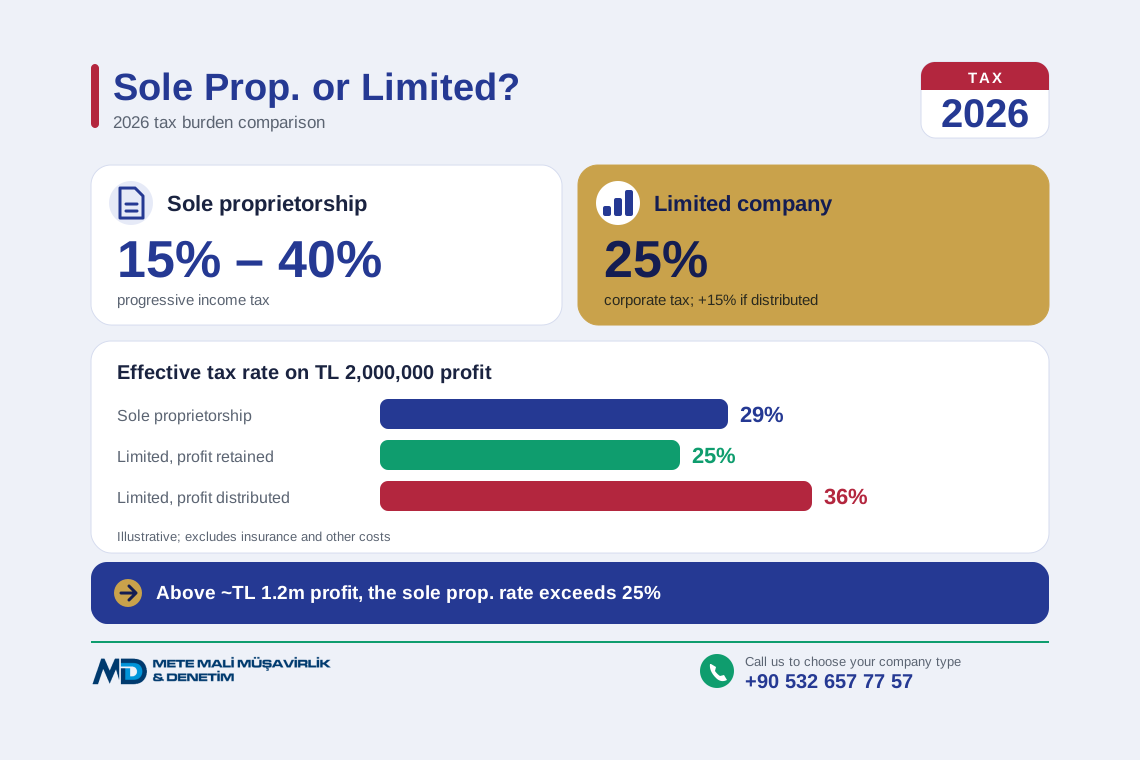
- TL 2,000,000 profit: Sole proprietorship about 29% (TL 582,500). Limited company about 25% (TL 500,000); if fully distributed, about 36% (TL 725,000).
- TL 3,000,000 profit: Sole proprietorship about 31% (TL 932,500). Limited company about 25% (TL 750,000); if fully distributed, about 36% (TL 1,087,500).
The takeaway: once profit goes above roughly TL 1.2 million, the effective tax rate of a sole proprietorship exceeds the limited company’s 25%. However, this advantage depends on leaving profit in the company. If profit will be withdrawn by the partners every year, the limited company’s total tax burden can remain higher than that of a sole proprietorship.
Which One in Which Situation?
- A sole proprietorship may suit you better: if profit is low to moderate, if you are just starting, if capital and risk are limited, or if a simple one-person structure is enough.
- A limited company may suit you better: if profit is high and most of it will stay in the company, if you will take on partners, if you want to separate personal assets from commercial risk, or if you want a stronger structure for banks, suppliers and corporate customers.
- The decision is not permanent: as the business grows, a move from a sole proprietorship to a limited company can also be planned.
Points to Consider Beyond Tax
- Cost and workload: Books, certification and accounting costs are usually higher in a limited company.
- Liability: A sole proprietorship carries personal asset risk.
- Partnership: Taking on partners or transferring shares is possible in a limited company; a sole proprietorship is tied to one person.
- Withdrawing profit: Taking profit out of a limited company is subject not only to tax but also to legal and accounting rules.
Decision Checklist
- Set a realistic annual profit expectation for the next 2-3 years.
- Calculate how much profit you will leave in the company and how much you will withdraw.
- Consider whether you will take on partners and what your debt risk is.
- Think about your banking, tender and corporate customer needs.
- Calculate insurance obligations and other costs together with your accountant.
At Mete CPA & Auditing, we calculate both a sole proprietorship and a limited company for you based on your expected profit, partnership structure and risk profile, and support you from setup to conversion. Contact us to review your situation.