Under Presidential Decree No. 7887, published in the Official Gazette dated November 25, 2023 (No. 32380), the minimum share capital amounts for joint-stock companies (A.Ş.) and limited liability companies (Ltd. Şti.) in Turkey were significantly increased. Subsequently, Law No. 7511, published in the Official Gazette dated May 29, 2024 (No. 32560), granted existing companies a transition period to comply with these new amounts. In this article, we summarize the new minimum capital requirements, the deadline, and the consequences of failing to increase capital in time.
İçindekiler
What Are the New Minimum Capital Amounts?
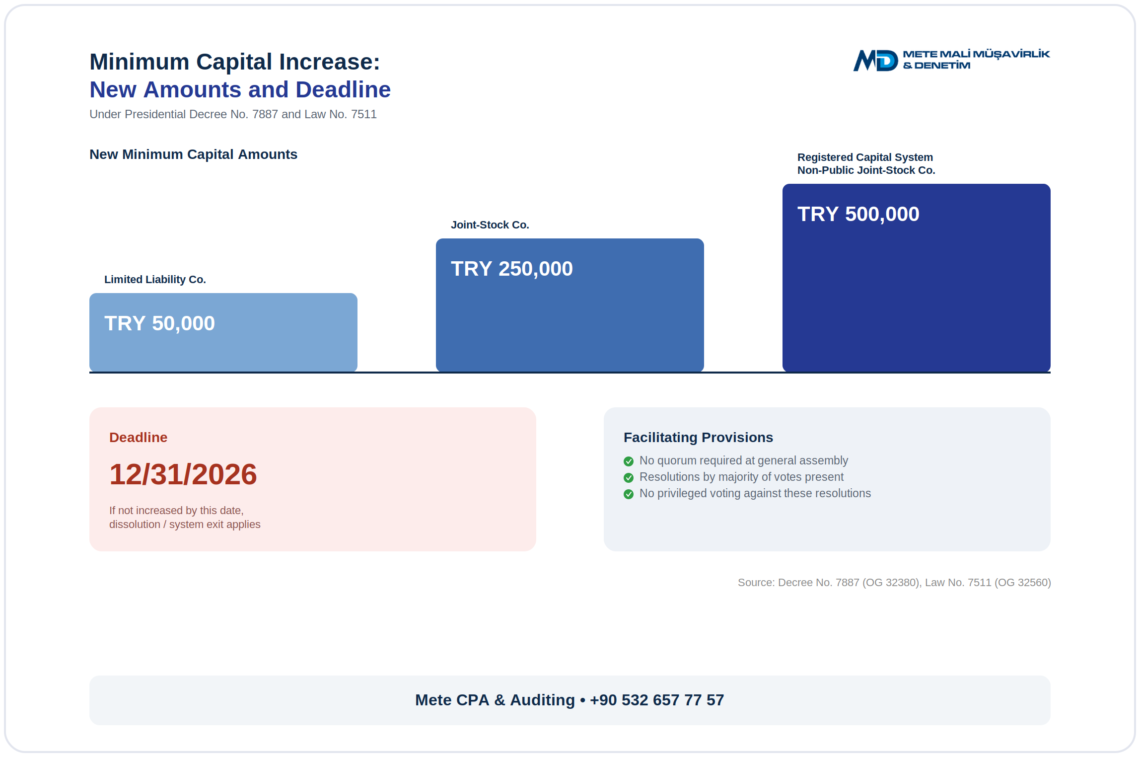
Under Presidential Decree No. 7887, the minimum capital amounts set out in Article 332 of Turkish Commercial Code No. 6102 were raised as follows:
- Joint-stock companies (A.Ş.): from TRY 50,000 to TRY 250,000
- Limited liability companies (Ltd. Şti.): from TRY 10,000 to TRY 50,000
- Non-public joint-stock companies operating under the registered capital system: initial capital raised to TRY 500,000
These new amounts became directly applicable to newly established companies as of January 1, 2024.
Transition Period for Existing Companies
Provisional Article 15, added to the Turkish Commercial Code under Article 17 of Law No. 7511, granted a transition period to companies established before January 1, 2024 whose capital falls below the new minimum amounts. Accordingly:
- Joint-stock companies with capital below TRY 250,000 and limited liability companies with capital below TRY 50,000 must raise their capital to these amounts by December 31, 2026.
- Non-public joint-stock companies under the registered capital system with issued capital of at least TRY 250,000 must raise both their initial and issued capital to TRY 500,000 by the same date.
To facilitate this process, the legislator provided that general assembly meetings held to increase capital to the minimum amounts will not require a quorum, resolutions will be adopted by a majority of votes present, and no privileged voting rights may be exercised against such resolutions.
What Happens If Capital Isn’t Increased in Time?
This carries a serious consequence that should not be overlooked:
- For joint-stock and limited liability companies: if capital is not raised to the minimum amount by December 31, 2026, the company is deemed dissolved — meaning it is legally considered to have ceased to exist, and liquidation proceedings begin.
- For non-public joint-stock companies under the registered capital system: if capital is not raised to TRY 500,000, the company is deemed to have exited the registered capital system.
Although the Ministry of Trade has been granted authority to extend this deadline by up to one year, twice, taxpayers should plan their process now rather than relying on the possibility of an extension.
Recommendations for Companies
- Check whether your company’s current issued/registered capital falls below the new minimum thresholds.
- Plan the required general assembly and registration process for the capital increase well in advance; don’t leave it until the final quarter of 2026.
- Work with your CPA to decide whether the increase will be in cash or in kind, the payment schedule, and its effects on your current ownership structure.
- If your company operates under the registered capital system, make sure both your initial and issued capital meet the TRY 500,000 threshold.
- If you are planning to set up a new company, you can review the current capital requirements in our guide to establishing a limited company.
At Mete CPA & Auditing, we support you from determining your company’s capital increase obligation to fully managing the general assembly and registration process. Contact us to review your situation.