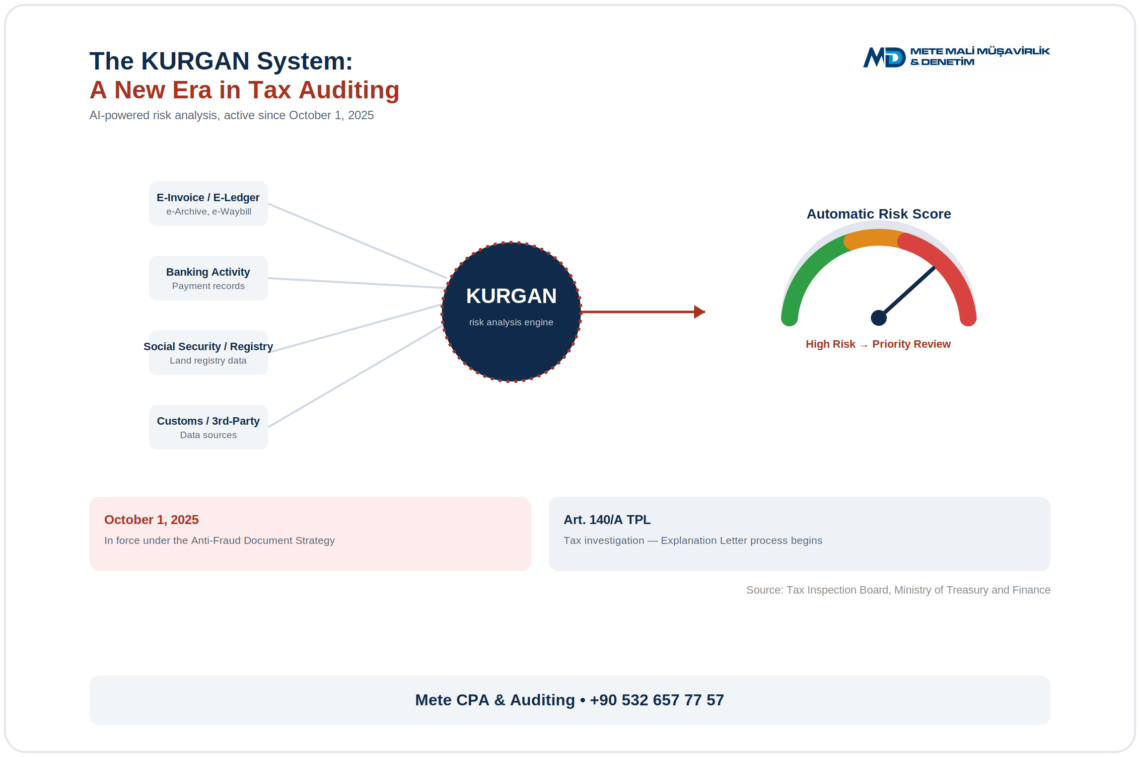
As of October 1, 2025, Turkey’s Tax Inspection Board, under the Ministry of Treasury and Finance, entered a new era in the fight against fraudulent documents and tax evasion. Introduced under the “Strategy for Combating Fraudulent Documents,” the KURGAN system (Institution-Supervised Analysis System) is a centralized, AI-powered risk analysis system that monitors taxpayers’ transactions in real time. In this article, we summarize what KURGAN is, how it works, and the precautions taxpayers should take.
İçindekiler
What Is KURGAN?
KURGAN was introduced under Article 140/A (tax investigation) added to the Tax Procedure Law, and is an AI-powered risk analysis system that screens taxpayers’ historical and current data. The system does not create a new tax obligation by law; rather, it acts as a selection and early-warning mechanism that determines which taxpayers are prioritized under the existing tax audit authority (Article 134 of the Tax Procedure Law).
The End of the “Unknowing Use” Defense
Before October 1, 2025, the defense that a fraudulent document was used unknowingly (“we didn’t know,” “how could we have known”) could be taken into account during tax audits. Under the new regulation, the use of a fraudulent document is presumed to be intentional; company executives who cannot prove the actual content of a transaction may now be directly assessed within the scope of tax evasion.
How Does KURGAN Work?
The system integrates and analyzes data from numerous digital sources in real time:
- E-invoice, e-archive, e-waybill, and e-ledger records
- Banking transactions and payment records
- Social Security (SGK) employee declarations, Trade Registry, and Land Registry (Title Deed) data
- Customs transactions and data obtained from third parties
KURGAN compares each taxpayer’s transactions against their own commercial flow and sector averages to generate an automatic risk score. Importantly, the system flags the transaction as risky, not the taxpayer directly. Transactions with a high risk score are prioritized for review instead of being selected through traditional random audits, and audits are now conducted on the current period rather than years after the fact.
The Request for Information / Invitation to Explain Process
When KURGAN identifies a transaction as risky, the taxpayer receives an Explanation Letter (Request for Information / Invitation to Explain) via e-notification. The taxpayer must prove, with documents and explanation, that the goods or services purchased were genuinely used in production or business activity. If the explanation is found sufficient, the matter is closed; if not, the taxpayer is referred to a formal audit, and where warranted, notified to the Public Prosecutor’s Office through the Tax Inspection Board, MASAK, and tax offices.
Key Risk Areas the System Flags
- Invoices of unusual size inconsistent with the company’s turnover, employee count, or sector profitability
- Expenses or profit/loss declarations inconsistent with sector averages (persistent losses or perpetual input VAT carry-forwards)
- Inconsistencies between delivery notes and PTS (Plate Recognition System) / HGS (Electronic Toll Collection) route records
- Transactions where no clear link can be established between payment documents and the paying/receiving parties
- Documents obtained from short-lived, shell-like companies
- Failure to issue invoices for sales exceeding TRY 9,000; failure to issue daily Z-reports even on days without sales
Precautions Taxpayers Should Take
- Verify the reliability of the companies from which you purchase goods or services.
- Ensure invoice contents are consistent with your turnover, employee count, sector profitability, and warehouse capacity.
- Confirm that goods or services purchased are directly related to your line of business.
- Check that VAT amounts are proportionate to your overall purchase volume and not unusually large.
- Make sure delivery notes exist and are consistent with route records (PTS/HGS).
- Make payments by bank transfer or check; payments made by promissory note carry higher risk in tax audits.
- Ensure receipt-based expenses are proportionate to your company’s size and workforce, and can be clearly explained.
- Consult your CPA before proceeding with any transaction you consider risky.
Why It Matters
With KURGAN, tax auditing has shifted from a random check conducted years later to a data-driven process triggered at the moment a transaction takes place. This makes proactive compliance far more important for taxpayers: assessing the risk of a transaction before it happens is significantly less costly and less stressful than responding to an Explanation Letter afterward. Identifying the risk areas your company may face under KURGAN in advance is critical to being prepared for a potential Invitation to Explain.
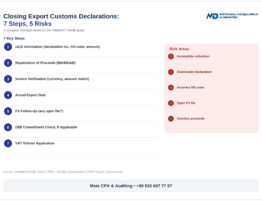
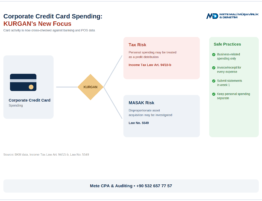
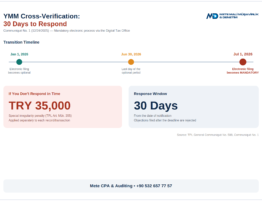
Related articles: For specific compliance points under KURGAN, see our guides on YMM cross-verification records and corporate credit card monitoring. Since customs data also feeds into the system, our Export Customs Declaration (GÇB) Closure guide is also relevant, and for resolving existing tax non-compliance, see Asset Peace 2026.
At Mete CPA & Auditing, we support you from assessing your transactions against KURGAN’s risk criteria to managing a potential Explanation Letter process. Contact us to review your company’s compliance position together.