Turkey’s Ministry of Treasury and Finance has fully digitalized the cross-verification (karşıt inceleme) process used by Sworn-in Certified Public Accountants (YMM), through Communiqué No. 1 on the electronic submission of cross-verification records attached to YMM certification reports, published in the Official Gazette dated December 24, 2025 (No. 33117). In this article, we summarize how the process works, the transition timeline, and the penalties that apply when a response is not submitted on time.
İçindekiler
What Is a Cross-Verification Record?
When preparing certification reports — such as full certification or VAT refund reports — YMMs conduct cross-verification to confirm the authenticity of transactions between the taxpayer and the companies it does business with. The records produced through this process form an integral part of the certification report. Under the new regulation, these records are no longer prepared on paper; they are now created, approved, and sent to taxpayers electronically through the Digital Tax Office (dijital.gib.gov.tr).
An important threshold: for 2026, cross-verification is not mandatory for documents with a value (excluding VAT) of up to TRY 150,000.
Transition Timeline
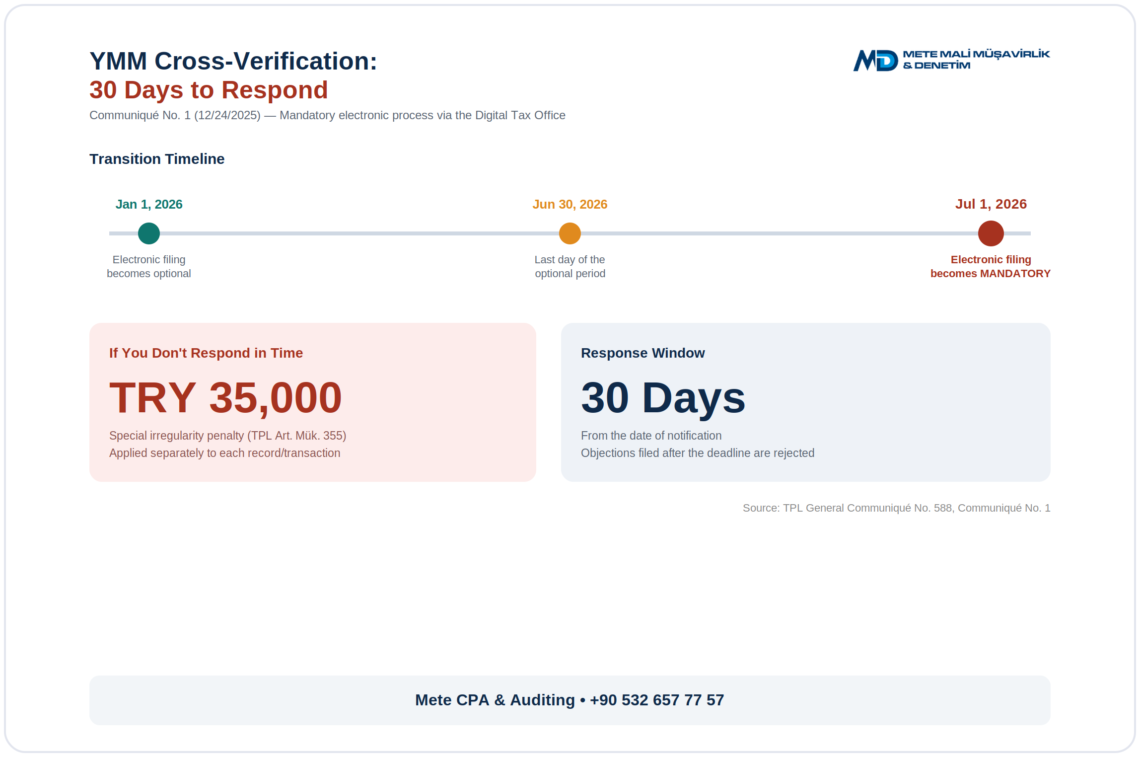
- January 1 – June 30, 2026: Electronic submission is optional; paper records remain valid during this period.
- As of July 1, 2026: Electronic submission becomes mandatory. Cross-verification records prepared on paper after this date cannot be submitted to tax offices; even if submitted, they carry no legal validity and are treated as “never having been prepared.”
This can cause a YMM’s certification report to be considered incomplete and may halt processes such as VAT refunds for the taxpayer — meaning this is no longer solely the YMM’s responsibility to track, but the taxpayer’s as well.
What Taxpayers Must Do: The 30-Day Window
Taxpayers subject to cross-verification must respond to the YMM’s request within 30 days of notification. Responses are treated as an official document signed by the taxpayer or their authorized representative. Taxpayers may also grant sub-user authorization to their accountant (SM/SMMM) under an agency and liability agreement, allowing the accountant to manage this process on their behalf.
What Happens If You Don’t Respond in Time?
Taxpayers who fail to respond to a cross-verification request within the deadline, or who provide incomplete or inaccurate information, are subject to a special irregularity penalty under Article Mükerrer 355 of Tax Procedure Law No. 213. For 2026, this penalty was set at TRY 35,000 for first-class merchants (i.e., corporations) and self-employed professionals under General Communiqué No. 588 on the Tax Procedure Law — and this amount can apply separately to each individual record/transaction. For example, if 20 cross-verification requests go unanswered in a single year, the total penalty can quickly reach hundreds of thousands of lira.
Recent cases also show that objections to tax/penalty notices issued due to late responses are being rejected — underscoring how seriously this process is now being enforced.
The Connection to KURGAN
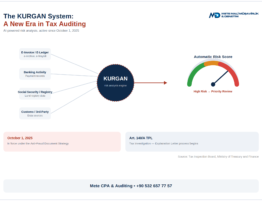
This digitalization and increased enforcement of cross-verification did not happen in isolation. Viewed alongside the KURGAN risk analysis system covered in our earlier article, it becomes clear that the tax administration is systematically strengthening its ability to cross-check taxpayer declarations against third-party data. Inconsistencies in cross-verification records can directly affect a taxpayer’s KURGAN risk score.
Recommendations for Taxpayers
- Monitor notifications from the Digital Tax Office closely; don’t miss e-notification alerts.
- When a cross-verification request arrives, contact your CPA immediately rather than waiting until close to the 30-day deadline.
- Grant your CPA sub-user authorization so the process can be professionally managed on your behalf.
- Remember that paper records will no longer be valid after July 1, 2026 — make sure your YMM is also prepared for this transition.
At Mete CPA & Auditing, we support you in responding to cross-verification requests from the Digital Tax Office accurately and on time, helping you avoid special irregularity penalties. Contact us to review your situation.