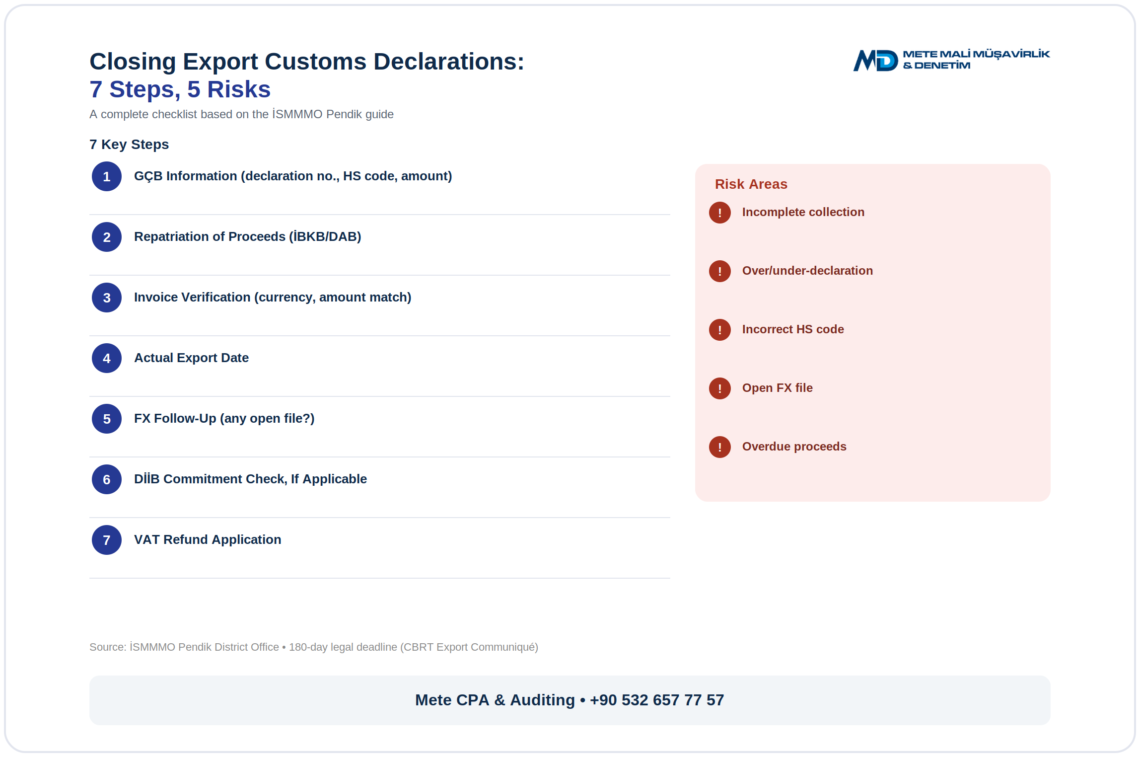
As highlighted in a guide prepared by the Istanbul Chamber of Certified Public Accountants (İSMMMO), Pendik District Office, properly closing the Customs Exit Declaration (Gümrük Çıkış Beyannamesi, “GÇB”) for export transactions is key to avoiding serious consequences such as tax penalties, loss of incentives, and delayed VAT refunds. In this article, we summarize the 7 key steps in the GÇB closing process and the risk areas to watch for.
İçindekiler
What Is a GÇB and Why Must It Be Closed?
The Customs Exit Declaration (GÇB) is the official document confirming that goods have been exported from Turkey’s customs territory. However, filing the declaration alone is not enough — a series of follow-up steps, from bringing export proceeds into the country to filing the VAT refund, must be completed in full to close the file. A GÇB file left incomplete can create risks of tax audits, incentive clawback, or administrative fines under foreign exchange regulations.
7 Key Steps in the GÇB Closing Process
1. GÇB Information
Verify that the declaration number is correct, and that the HS code (Harmonized System / customs tariff classification), quantity, and amounts match the invoice exactly.
2. Repatriation of Export Proceeds
Confirm whether the export proceeds were brought into the country within the legal deadline, and whether an Export Proceeds Acceptance Certificate (İBKB) or Foreign Exchange Purchase Certificate (DAB) was issued.
3. Invoice Verification
The e-export invoice must match the GÇB exactly; the currency and amount must be identical on both documents.
4. Actual Export Date
Check whether the declaration’s closing date is consistent with the accounting records.
5. Foreign Exchange Follow-Up
Confirm whether any open (unclosed) export file remains and whether bank records are up to date.
6. If an Inward Processing Certificate (DİİB) Applies
For exports made under an Inward Processing Permit Certificate (DİİB), check whether the transaction has been recorded against the export commitment and whether the records required to close the certificate are ready.
7. VAT Refund
Confirming that the GÇB has been closed and that the correct documents have been attached to the refund file is a prerequisite for the VAT refund process to conclude without delay.
Risk Areas to Watch For
Among the risk areas specifically highlighted in the İSMMMO Pendik guide:
- Incomplete collection: the full export proceeds not having been brought into the country.
- Over- or under-declaration: inconsistencies between the amount declared on the GÇB and the invoice or amount collected.
- Incorrect HS code: misclassification of the goods’ customs tariff position.
- Open foreign exchange file: bank files left unclosed because entry of export proceeds was not completed.
- Overdue export proceeds: proceeds not brought into the country within the legal deadline (as a general rule, 180 days from the actual export date).
Overlooking these risk areas can result in tax penalties, loss of incentives, delayed VAT refunds, and administrative fines under foreign exchange regulations.
Deadline for Repatriating Export Proceeds
Under Communiqué No. 2018-32/48 relating to Decree No. 32 on the Protection of the Value of Turkish Currency, and the CBRT’s Export Communiqué, proceeds from export transactions carried out by residents of Turkey must, as a rule, be transferred or brought in directly and without delay following the importer’s payment. As a general rule, the deadline for repatriating proceeds cannot exceed 180 days from the actual export date. Once the proceeds are brought into the country, banks must issue an İBKB or DAB.
Recommendations for Exporters
- Apply the 7-step checklist in full for every GÇB file.
- Confirm that export proceeds were repatriated within the 180-day deadline and that an İBKB/DAB was issued.
- Regularly monitor any open foreign exchange files and keep your bank records up to date.
- Make sure the GÇB is closed before filing a VAT refund claim.
- Don’t neglect the commitment-closing process for exports made under an Inward Processing Certificate (DİİB).
At Mete CPA & Auditing, we support you throughout the entire process — from fully closing your GÇB files and ensuring compliance with foreign exchange regulations, to tracking your VAT refund process and identifying potential risks in advance. Contact us to review your situation.